

Do Not Resuscitate:
The vast chasm between expectation and reality

“I don’t want to live anymore” croaks Gertrude, the 80 year old lifetime smoker with new chest pain atop decades of heart failure and COPD. To the consternation of her critical care nurse, she pushes off her oxygen mask for the 7th time in 20 minutes to utter between ever-bluer lips:
“I don’t want heart surgery or angioplasty, just let me go to Jesus…
…or have a cigarette.”
Gertrude’s cardiologist and primary care physician very reasonably agree to make her a DNR: Do Not Resuscitate, so that she isn’t burdened with any invasive or uncomfortable life-extending interventions in the face of an all-but-certain appointment with the reaper.
But as it turns out, Jesus didn’t want to cruise the endless vistas of heaven with Gertrude just yet. She pulled through nicely despite her big, Red Foxx-style heart attack.
In fact, she recovered so well that months later, she broke her hip playing Wii Pickleball at the nursing home. Now Gertrude wants her hip fixed electively, because she doesn’t want her neighbor in memory care -who she affectionately refers to as “that revolting slut, Eunice,” to beat her high-score while she sits on the sidelines in rehab. Hard-fought dominance must be defended against pretenders to the throne.
Gertrude has a new fire in her chest, and it isn’t reflux: it’s a burning desire for orthopedic surgery to vanquish any challengers to her athletic supremacy in the retirement home.
Or maybe it’s just another heart attack… but no one checked because… she’s a DNR after all.

Reaper in the kitchen? The Devil’s in the details.
“I don’t want any heroic measures: just fix my leg.”
Since Gertrude is a DNR, she is not sent for a pre-surgical evaluation to see if she is a good candidate for preoperative care that might optimize her chances of survival, because she doesn’t want all of that grief about smoking from her cardiologist or pulmonologist. Don’t they know that she’s a DNR??
In her defense, even though she can’t bear weight on that freshly replaced hip for a bit, a post-cardiac-arrest afterlife of floating amongst the clouds is not a weight-bearing affair either, and lack of a measure of optimization only makes an ethereal outcome more likely.
Being a DNR will get you way less screening and overall wellness evaluation specifically because you have identified yourself as someone who has made their peace with the world: prepared to gracefully shed their mortal husk on a moment’s notice. Having elective surgery as a sick, elderly person who has not been optimized for surgery because of their DNR status is basically the X-Games for octogenarians: exciting for the spectators, stressful for the officials, and quite dangerous for the participants. Keep in mind: participation is voluntary.
Or is it?
What do patients think DNR means?
Everyone wants to be DNR these days, but no one really knows what it is. Whenever I ask a patient why they are a DNR, 9 times out of 10, they tell me the exact same thing:
“whelp, I just don’t want to be a VEGETABLE, doc!”
This is relatable, because the thought of being a vegetable is extremely unappealing. Even the most deeply depressed nihilist doesn’t perseverate upon their existential misery, longing for a persistent vegetative state to ameliorate it… they long for death. So this concern is also a bit absurd because no one wants to be a vegetable, and it’s not actually a decision-making point on how to proceed with managing “bad things.”
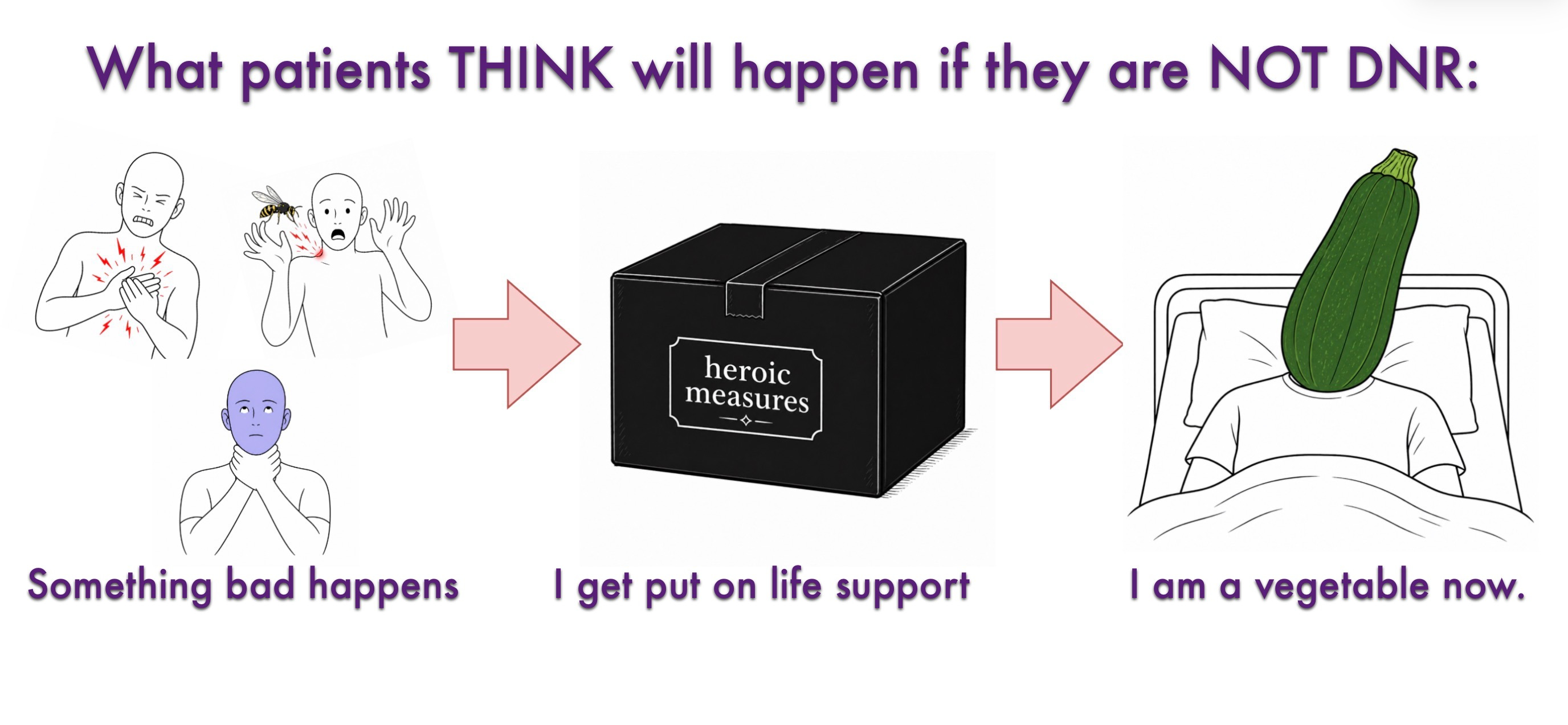
This is simple, but not how it really works. The truth is a lot more nuanced -but not to the point of being hard to understand, so follow me on a whimsical journey through end-of-life planning!
While the process does get kicked off with “bad things,” the specifics of how they impact the effectiveness of your heart and lungs determine how you are treated, and your response to those treatments determine how likely you are to remerge as a philosopher or as a zucchini -if you emerge at all.
What it actually means to get “heroic measures:”
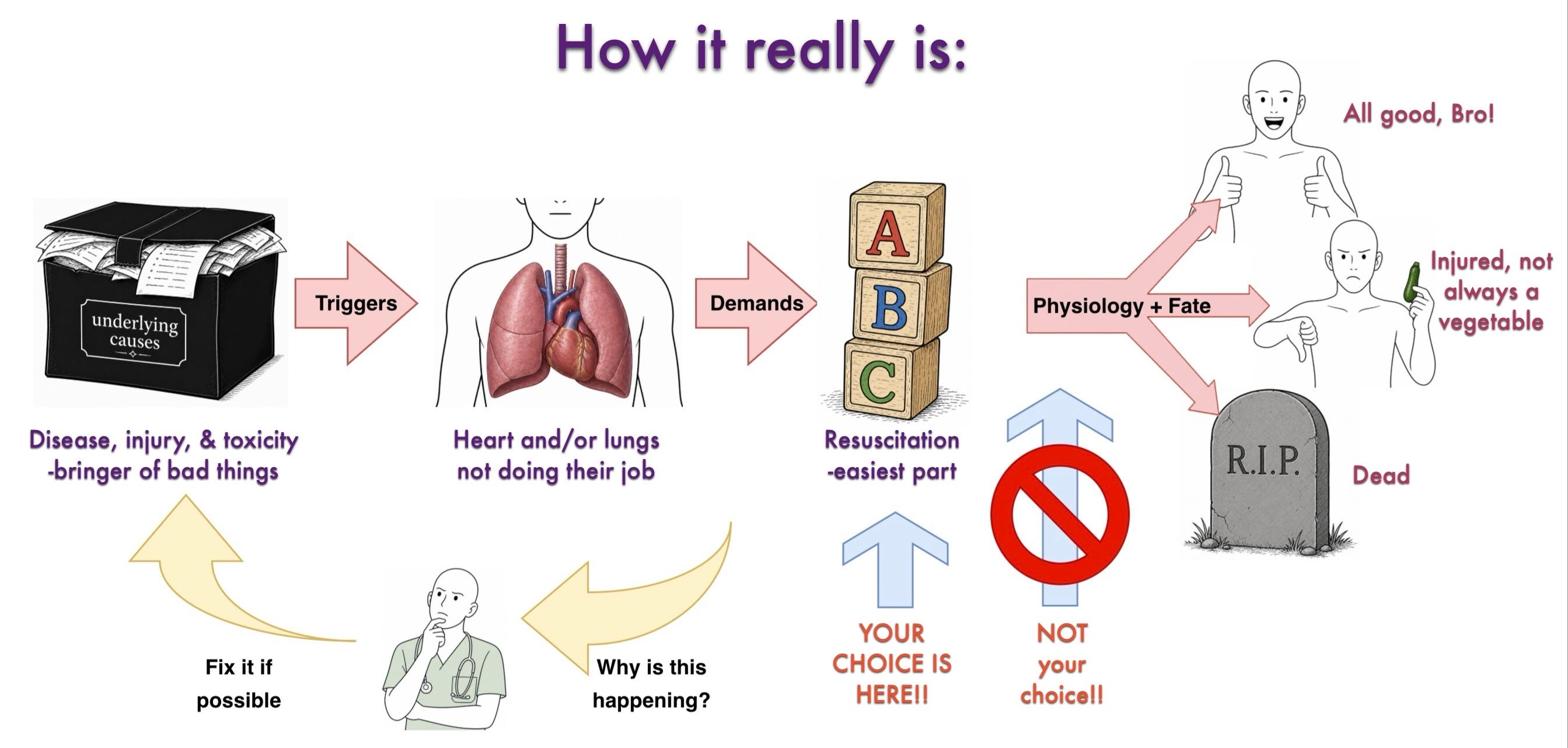
The pink arrows represent your catastrophic journey through time from beginning to end. Something happens, either dramatically or insidiously, causing your thoracic organs to tire and fail. It could be a lifetime of bad decisions or random misfortune in the peak of youthful athleticism -there is no justice in nature, only probability peppered with chaos.
Maybe you choke on a piece of steak, or succumb to decades of sedentary cigarette consumption. Maybe you’re toxic because you ate a bunch of powdered avocado pits on the advice of some dipshit on Rumble or Instagram. Maybe you’re septic from an undercooked hamburger. The point is… the list of items in the black box of underlying causes is enormous, but each can find a path to overwhelm your heart or lungs. They don’t need to stop working completely, they just need to come up short. They don’t even need to both fail: if only one of the two organs fall asleep on the job, you will face a team of folks ready to “code” you, conscious or not. So it’s important to understand how and why.
Code Blue, party of one
Your restaurant may have only one chef, but your meal had a whole team of people to assemble and serve it to you. Getting resuscitated is similar to going the Cheesecake Factory on your birthday, except the whole team shows up with a defibrillator instead of a cake with sparklers on it. Just as the other patrons in a restaurant are quietly relieved that they aren’t the center of attention as they gaze upon the embarrassing spectacle of singing waiters, neighboring patients who witness the sweaty cluster of activity that a code brings quietly give thanks that they aren’t the star of that show.
While resuscitation is physically demanding, it’s pretty intellectually straightforward:
Not breathing? Establish an airway and ventilate.
Not circulating blood? We will forcibly squish it around your body until we can persuade your heart to do it for you again.
These efforts range from simple jaw thrusts and chest compressions, to elaborate ventilators and circulatory-assist devices, but all accomplish the same things: oxygenate and circulate blood. They are collectively labeled “life support” in the average non-medical person’s mind, and while that isn’t wrong, it’s overly simplistic. But before we get to that, let’s talk more about the arrows on the chart again.
The yellow arrows represent how your problem necessarily becomes someone else’s problem. While your team struggles to keep you alive in your moment of crisis, they also have to dissociate from the chaotic excitement and think about why you have gathered these dearly beloved strangers together in your room. Yes, your heart is fibrillating and your lungs are too stiff and your complexion too pale -but WHY? Are you bleeding internally? Suffering from some genetic time-bomb? Did your spouse poison you? Is there clot in your lungs or thrombosed plaque in your coronary arteries?
None of these things are necessarily obvious to anyone in the room, as most have never met you before. Being tasked with managing your immediate life support is stressful (particularly to the inexperienced), but this focused reflection must occur, because the act of resuscitation by itself -while critically important to saving you, amounts to nothing if the cause of your predicament is not discovered. I will spare you the details of this process because it will exceed the character limit for Substack articles.
Finally, the blue arrows illustrate what you can and cannot affect with your own will and agency. You can demand -or refuse- resuscitation. You cannot demand how it ends -even if its predictable in certain circumstances.
But doc… I don’t want to be a vegetable!
BROTHER, I know!! But that’s like being gay: it’s not a choice.
You don’t get to choose the severity of your disease or the effectiveness of available treatments when the Reaper awkwardly puts his arm over your shoulders like a 13 year-old on his first date. What you do get to choose is if anyone will even try to pry you from his cold embrace.
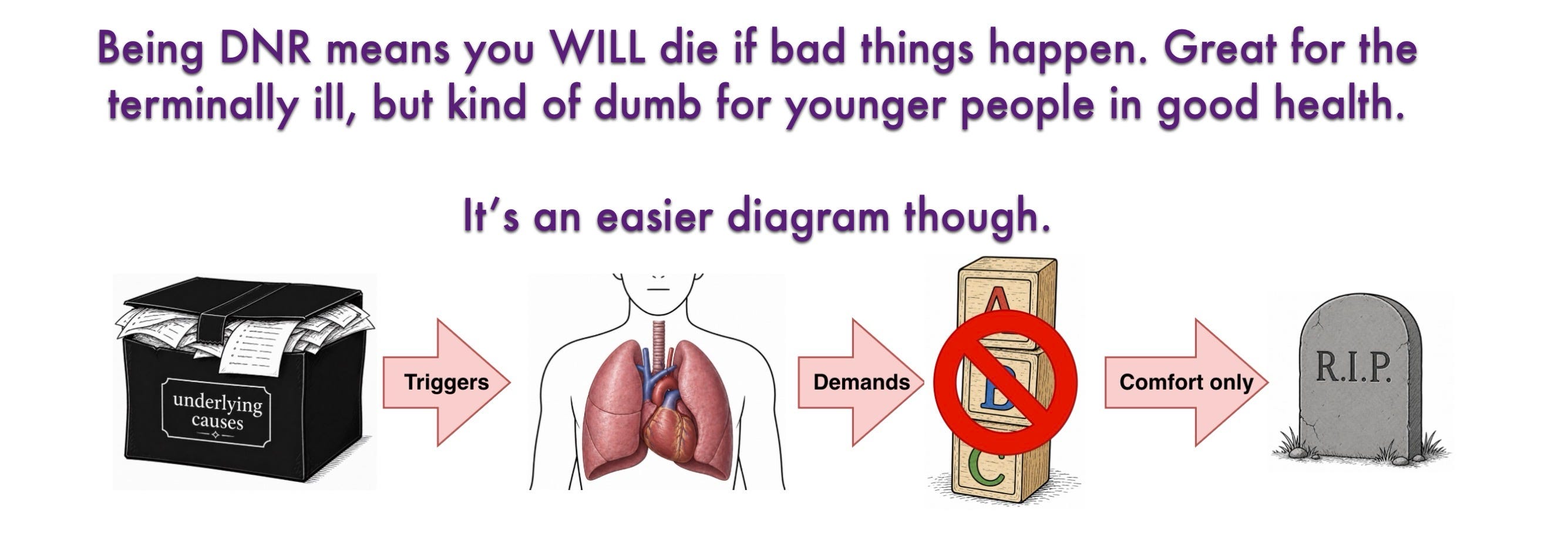
If you are 25 and have a spontaneous bout of ventricular fibrillation while playing basketball, getting CPR until a defibrillator arrives is likely to bring you back and in a condition ready to play again tomorrow (but maybe see a cardiologist first).
If you think its cute to tattoo “DNR” to your chest, you might skip a chance at continuing to live your edgy life, and everyone in the afterlife will laugh at you for being so recklessly stupid -if the afterlife appreciates a measure of dark irony. I sincerely hope that it does, but I don’t know for sure yet.
If you are a frail 90 year old, riddled with metastatic cancer and suffering from congestive heart failure, you probably shouldn’t be a full code because you are incredibly unlikely to survive, and if you do… you are going to be so pissed with a breathing tube and all those broken ribs.
Being old and frail, or suffering from a terminal disease are just two GREAT reasons to be DNR. You are already dying, you are likely suffering, and you are unlikely to have the constitution to come back from whatever causes your arrest. If you do come back, you will be in poorer condition than you started, and you have to wonder if it was worthwhile.
That being said, I do get people in this category who’s family demand all efforts to be made to keep them going because “they’re a fighter,” even though it is quite clear as this broken soul who lays unresponsive amidst a web of tubes and wires, has insufficient “fight” left in them to participate in a conversation -let alone protest 24-hour dialysis and ventilation. While it should be obvious, the moral of this story is: choose wisely the person who speaks for you when you cannot speak -their indecisive guilt will be your enduring physical torment.
The problem is the nuance in the gray areas
Let’s say you’re 50. That’s young even though I didn’t think so as a newly minted doctor in my late 20’s. Seemed old. Now that I’m there, it’s young -trust me. You have plenty to live for, right? Decades more in a motorhome or bouncing grandchildren on your increasingly arthritic knee. Healthy as a slightly sway-backed horse! You should absolutely be a full code.
But let’s say you also have stage 4 Hodgkin lymphoma. Shitty, but there are worse cancers to have, because you have north of a 50% chance of living another 10 years! Thats still a lot of time in the RV or with the grandkids. So if you show up for elective knee replacement to better bounce that adorable baby, it would be reasonable to still be a full code if something rare but immediately life threatening occurred during the surgery that necessitated a resuscitation, like say, a bone marrow embolism. Even if you woke up with broken ribs from chest compressions, you’re gonna be fine for a good long while after you heal up!
But what if you had a shittier cancer? Like… non-small cell lung cancer. Now you realistically have a year or two to live. It would be weird to even consider a knee replacement, but some people do and I’ve seen weirder (like this lady who had a gastric bypass while suffering from leukemia, but that’s a different story). In this case, it is totally reasonable to be DNR, because while you may want your knee fixed, your bottle of Worcestershire sauce has a longer shelf life than you do. It’s nice to get a new joint that works, but it’s also peaceful to die under anesthesia in lieu of facing a rapid, suffering decline from metastatic cancer. On the other hand, maybe you have something or someone you really want to live for in those 2 remaining years -so it is also totally reasonable to be a full code.
Assigning your code status is like going to Burger King: you can have it your way. Sort of.
I like to tell patients that there are no right or wrong answers when they understand the process. When they don’t understand the process, it’s nothing but wrong answers.
Your wishes on how you are cared for are supreme. Full stop.
But if those wishes are oddly out of sync with your health, hopefully, one of your providers will address it with you to make sure that you will get what you think you want, because there is lots of room for misunderstanding in matters of death, where both patients and (sadly) some clinicians are reluctant to discuss things that are scary and/or depressing. I am not one of those clinicians. I want to be on the same page with my patients even if we have to talk about stuff that makes holiday dinners super awkward.
Generally speaking:
If you are very old yet very healthy: Any DNR status is acceptable.
If you are any age and very debilitated from chronic illness or frankly dying of a terminal disease: Any DNR status is acceptable.
If you are very old and frail: Any DNR status is acceptable, but you should understand that if you are a full code, you are going to be in rough shape on the other end of it. A lot of folks don’t understand this and some change their minds. Others persevere but have a better idea of what they are signing up for.
If you are under ~70 and healthy: you probably shouldn’t be a DNR. I mean, you can be if you want to, but there is a high probability that you don’t understand that you’re asking to die unnecessarily if anything weird happens (and it does).
Code status should always be addressed, but deviation from these principles should spark a deeper conversation. Your wishes will be respected, but it’s important that clarity is established when it seems like a DNR is unwarranted, or when a full code will multiply your suffering. Hospitals are not haunted by the souls of the departed, so much as the regrets of the living.
That’s why you can treat your advance directives on resuscitation as salad bar of sorts. It’s okay to have some parts of it, while refusing others. And you can’t eat the metal bins that hold the salad, because that’s bad for everyone -especially you.
Options break down to:
Breathing tubes (which require the use of a ventilator)
Drugs to keep you alive or bring you back from near-death
Application of electricity to your heart for pacing or defibrillation, and
Application of force in the form of chest compressions to circulate blood to your organs when your heart calls in sick to work.
You can agree or disagree to any of that, generally speaking. But… when you show up to the OR as Gertrude did, there are additional constraints.
If you are a DNR and want surgery, you are going to have to agree to a breathing tube to make anesthesia possible. Yes, you could have this done under spinal anesthesia to avoid a tube, but one of the complications of a spinal is also forgetting to breathe, and there are not many of us who would agree to killing you with a spinal by forgoing the placement of a breathing tube to get you through an entirely temporary problem that we caused.
There is constraint in the refusal of drugs called vasopressors as well. Every kind of anesthesia will lower your blood pressure: we have to be able to give those to keep you alive through man-made conditions. Most people don’t really care about this, as I have never had a single person refuse.
Now… if you don’t want to be shocked or have CPR? Totally fine. Mainly because that doesn’t come up most of the time, and when it does, we understand that this was what you wanted if fate chose violence. You can even further specify that shocks are ok (since they don’t hurt under anesthesia) but not CPR (because broken ribs do hurt after anesthesia). Or you can be a full code just for your surgery, and go back to being a DNR when you leave the recovery room. We are actually pretty flexible in matching your goals with what is medically possible, so long as you understand them too.
Communicate carefully. You never know if your doctor is more literal than Drax
One time, I had a 24 year-old dude with a hot gallbladder who was admitted to the hospital the night before he was scheduled for surgery. When I saw him in the morning, he was moderately sick. But he was also a bit overdramatic in the way that only sick dudes are. He wouldn’t open his eyes to talk to me. He would only answer my questions in as few words as possible. When I asked him to open his mouth as wide as he could, he clearly didn’t try at all. There was a lot of sighing and non-verbal cues telling me to fuck right off out of his room so that he could suffer in solitude until such time that I put him to sleep.
Interestingly enough, I noted that his chart was marked as DNR. He was young, healthy, and not suffering from any chronic diseases beyond soon-to-be-remedied gallstones -let alone terminal illness.
I asked: “I see you’re a DNR. Do you have cancer or something?”
He stirred, visibly confused and mildly annoyed, eyes cracked open as slightly as his facade of imminent death. “Ummm… NO. What are you talking about??”
“Your code status is ‘do not resuscitate,’ which means if something bad happens to you while you’re in the hospital, like a heart attack or a big pulmonary embolism, we will just make you comfortable in keeping with your desire to die.”
For the first time, his eyes were wide open, with slight panic: “WHAT?!?!? I don’t want that!!”
“I’m not surprised. That’s why I asked. Did you talk to anyone about this last night?”
Panic abruptly melted into anger before my eyes: “OH MY FUCKING GOD!!! Some guy kept pestering me with questions last night, and it was PISSING ME OFF, and so I told him ‘JUST LET ME DIE, OK?’ so it HAD to be him, right?”
“Yup. That was probably your hospitalist, or maybe your nurse, sir. He was asking you what you’d want us to do if you were dying. Can I go ahead and change that back to full code for you?”
“YES! AND I FUCKING HATE THIS PLACE!!!”
As his pillow was hurled forcibly across the holding bay, I realized that these are the tender moments of bonding with my fellow man that I live for. Another life saved from playful miscommunication.
Your wishes determine what we do… to an extent.
If your wishes don’t make sense, we are going to discuss that with you. That doesn’t mean we don’t care (quite the opposite), it just means that we want you to understand why it doesn’t make sense. Consider:
If you consent to being intubated, but not being put on a ventilator, you are 100% going to asphyxiate. The only viable alternative to a ventilator is having us blow in your tube, which you have to admit is gross, and we aren’t doing that short of a power failure.
If you are a full-code 85 year-old with crippling fibromyalgia, we might point out that surviving CPR might make you wish you didn’t, because neurontin just isn’t going to cover 20-24 rib fractures. Your call.
If you are 20 years old and want to be DNR because your favorite skincare product was discontinued, we may need to have a deeper discussion about the critical differences between advanced directives and advanced melodramatic hyperbole.
You must take the communication of your medical wishes seriously -even if like me, you are burdened with great, pendulous irreverence for everything else.
Appendix (not the kind that gets inflamed). Optional material
The following is just extra info on how terminology helps to clarify your wishes, and how it commonly leads to misunderstanding. Boring to those who know it, and still kind of boring to some who don’t. It’s of greatest interest to those who are affected by the decisions that spring forth (which is only the folks who will die one day), either personally or through a loved one that you charged with making decisions for.
** DOCUMENTATION **
Advance Directives (AD, or ACD) - Legal to semi-legal documents that express a patient’s wishes.
Umbrella term for written instructions about future medical care preferences. They are only written in stone if you never choose to change them, so feel free to change them whenever it seems appropriate.
Typically include a living will, plus an assignment for a surrogate decision-maker for when you can’t do it.
Living Will (LW)
Mostly describes what to do in terminal and permanently unconscious states (they are different).
Specifies which interventions a patient does and does not want. If I am ever in a vegetative state, I specify no anticoagulants, antibiotics, vasopressors, or dialysis, so that I can’t really linger even if my heart and lungs are healthy. Lots of people specify no tube feedings, but starving to death takes weeks. Sepsis, renal failure, or a pulmonary embolism are fast.
Durable Power of Attorney for Healthcare (DPA, DPOA, HCPOA)
Is, or appoints a surrogate decision-maker (SDM)for the patient
“Durable” just means that it remains valid if patient loses capacity, which is the whole point of this exercise.
Physician/Medical Orders for Life-Sustaining Treatment (POLST / MOLST / POST)
Medical orders, not just preferences (my weird preferences above would be converted to specific orders here when the time is near).
Completed with clinician; intended for seriously ill or frail patients
Travels across care settings (paramedics, nursing home, hospital, etc)
Abbreviations vary by state:
POLST (most states)
MOLST (e.g., NY, MA)
POST (some Midwest states, but not mine)
Goals of Care (GOC)
Structured discussion about the patient’s values and treatment preferences, either directly with them or through their surrogate on their behalf.
Often precedes changes to code status or POLST
** CODE STATUS AND RESUSCITATION ORDERS **
Like POLST, these are actionable medical orders within the chart.
Do Not Resuscitate (DNR, no-code, comfort care)
No CPR or defibrillation if cardiac arrest occurs
Typically means no endotracheal intubation as well, but it’s a gray area for no good reason.
DNAR – Do Not Attempt Resuscitation
More precise synonym for DNR that emphasizes low success probability.
DNI – Do Not Intubate
No endotracheal intubation (breathing tube).
May still allow CPR depending on context, which again, requires a conversation if it isn’t specified elsewhere. It’s always better to bring it up.
AND – Allow Natural Death
Reframes of DNR emphasizing comfort and non-escalation
Increasingly used in palliative settings
Full Code
All resuscitative measures will be done if the need arises.
This is the default status for everyone in a hospital or found unresponsive outside of a hospital in the absence of clear documentation to let you die.
** SCOPE OF TREATMENT / CARE GOALS **
These define how aggressive care should be overall, not just in arrest or near-arrest scenarios.
Comfort Measures Only (CMO -not to be confused with Chief Medical Officer).
Focus is exclusively on symptom relief
No disease-directed or life-prolonging interventions
Often implies transition toward hospice-level care
Comfort Care (CC)
Less rigid than CMO; can be used variably
Includes interventions if they improve comfort
For example, terminal cancer patients can develop bowel obstructions from abdominal tumors. They are extremely painful and cause constant nausea and vomiting. While surgically correcting the obstruction doesn’t stop the cancer from spreading elsewhere, resection provides immediate relief from a genuinely excruciating death.
DNR-CC / DNR-CCA (state-specific to Ohio -weird, huh? But they actually convey clearer information and deserve wider adoption)
DNR-CC: comfort care only immediately
DNR-CCA: full treatment until arrest, then no resuscitation
Limited / Selective Treatment
Intermediate level (e.g., antibiotics, fluids allowed; no ICU escalation)
** END OF LIFE CARE MODELS **
Hospice
Prognosis typically ≤6 months
Comfort-focused, usually no curative treatment
Palliative Care (PC)
Symptom management at any stage of illness
Can be concurrent with curative treatment
** Remaining pitfalls in the absence of clear communication and/or documentation:
DNR ≠ Do Not Treat: patients may still want antibiotics, pressors, ICU care, elective surgery, etc.
DNI without DNR creates internal inconsistency: e.g., CPR without an airway isn’t going to go well, but if it’s successful, you get to recover from broken ribs and aspiration of your last meal. Not great.
CMO vs CC often used inconsistently—clarify explicitly
POLST overrides much of this ambiguity, as it’s a signed medical order, not just general guidance.
“Vegetable-centered” framing of decision-making reflects poor public understanding of treatments and outcomes, and it absolutely is not a medically actionable category. You can decide what can be done to you (short of euthanasia) if you become a vegetable, but you can’t decide to avoid it by avoiding intervention altogether.
I think to myself, just let me go when it's my time.....I'm so tired.
Then, I choke on my beverage, and my first thought is, HALLLLLLLPPPPP!!!
Who knew that discussions about code status could be entertaining and educational? Absurdly Rational host, that is. Great post - my only quibble is listing someone as "a DNR" has a long evidence based history of be equated with a false identity based on willingness for an intervention - esp when the corollary takes over "DNR = DNT (Do Not Treat)".