

Detox Detonated my Aorta
The holistic, all-natural, one-step plan for emergent heart surgery

Have you ever wondered what lies at the intersection of high blood pressure, bad -yet ubiquitous- advice about the nature of addiction, and unplanned cardiac surgery? Nothing as serene or boring as this picture, I promise!
Facebook presented me a targeted ad for raw vegan food -as a substitute for medical care
Not because I’m into that. I mean, I do try to eat right until a breakfast burrito crosses my path, and then all restraint exits to make room for those carbs and nitrates. I am only human.
The algorithm only offered me this gem because it recognized that I thrive on other people’s bullshit takes on health and wellness. Eating healthy is unquestionably important to being healthy -but it is not a substitute for reality-based healthcare.
The company running this ad includes a heartfelt story about how its founder (a DJ) helped his mom to overcome leukemia via his miraculous diet -available for purchase on his website. If he can drop beats in the club, he can surely drop a few beets into your smoothie -just don’t expect it to cure cancer.
While plant-based diets reduce the incidence of several kinds of cancer, there is NO evidence that it specifically reduces the incidence of leukemias. Most importantly, there is no evidence that any kind of diet whatsoever will treat your cancer once it is diagnosed (the condition described on the website). You actually need conventional, evidence-based treatment -as I strongly suspect this DJ’s mother received, since she survived. Targeted therapy and a stem-cell transplants are curiously omitted from the sales pitch.
I share this ad with you now only because:
I don’t anyone to fall for this sort of marketing sleight of hand, and
I have a personal experience to share on what can happen if you take this kind of advice.
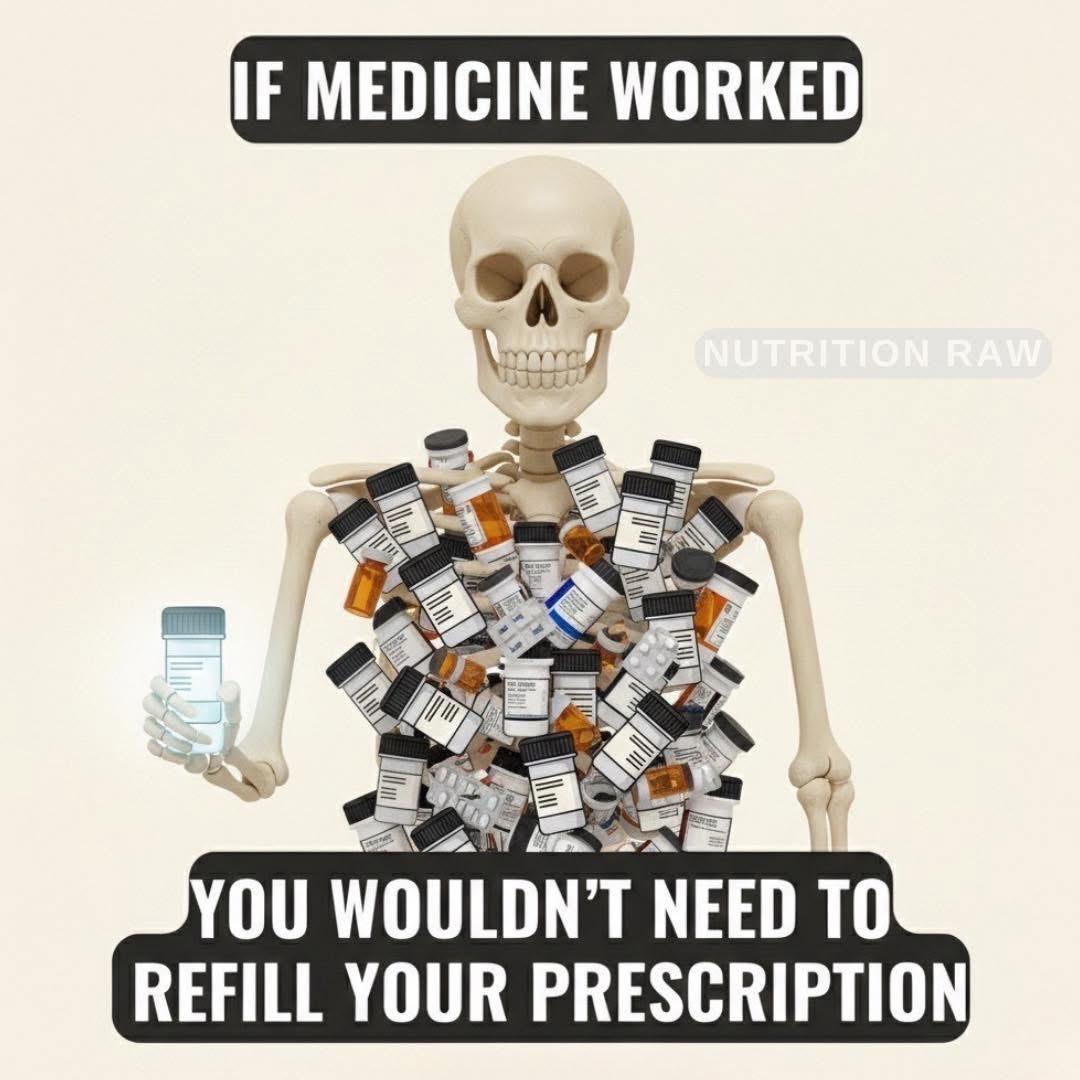
This ad falsely equates effectiveness with permanence, rejecting effective solutions because they don’t meet an impossible standard of lifelong perfection. A common strategy. Parachutes aren’t 100% effective and always need to be repacked, yet I don’t see many people jumping out of airplanes without them.
Skeletons make excellent spokesmen for brainless ideas, because in being stripped of all soft tissues, only an empty, bony head remains. Consider:
If clothes worked, you wouldn’t need to wear them every day.
If eyeglasses worked, you wouldn’t need to put them on every time you wanted to read without squinting.
If water worked, you wouldn’t need to drink it incessantly.
If raw vegan diets worked, you wouldn’t have to graze all day like a cow.
Thus, medications must be taken at the frequency they are prescribed in order to treat whatever it is that ails you. The fact that one must refill an insulin prescription to treat type I diabetes does not mean insulin doesn’t work. Scores of ER-bound folks in diabetic ketoacidosis prove each day that purposely discontinuing insulin is a disaster. Insulin works so well that you die if you don’t refill it.
So if medicine didn’t work as the meme implies, you could skip it without consequence. I’ll get to some notable consequences in a minute.
But if I need my medicine, does that mean I’m addicted to it?
It most certainly does not.
Addiction is real but often falsely extrapolated to nonaddictive drugs by laypersons -and particularly by alternative medicine practitioners: they know that if you think you’re addicted to prescription meds, they can leverage that fear into supplement or subscription sales.
There is a certain brutality in how alternative medicine strategizes growth of its influence. They recognize that it takes a certain amount of money to treat people with real problems like cancer, to depression, to high blood pressure and think:
“If I could convince people that my magic thoughts and magic beans work as well as -or better than- the evidence-based therapies that are available to them, I could collect that money.”
This ignores what might happen to patients who abandon effective treatment in favor of magic beans. But hey, that’s just good-old-fashioned entrepreneurialism, right? Like, subscribe, and caveat emptor!
Addiction is a chronic, relapsing disorder characterized by compulsive drug-seeking and abuse despite adverse medical and social consequences. While addiction can include physiological dependence, this does not define it the way all-consuming desire does. Drugs with high abuse potential create powerful internal rewards that cultivate intense cravings that persist even after a person is clean -that is what drives addiction.
Intense desire is the rule for alcohol or cocaine addiction, yet abstinence from alcohol (but not cocaine) leads to life-threatening physiologic withdrawal symptoms. Physical dependence is only a variable in addiction.
The sales pitch made by charlatans is that because you need insulin, or antidepressants, or high blood pressure medication every day, that you must be addicted to it. While that may be tempting to believe, it is utterly bogus.
Addiction is pathological desire, not biological necessity. A diabetic doesn’t “crave” insulin, they need it to survive, and their consumption is determined by physiology, not the limits of their compulsive yearning. Kidney failure patients aren’t addicted to dialysis -most of them hate the experience, but prefer it to a slow death of drowning in metabolic waste.
In today’s disinformation climate, it is easy for people feel addicted to anything they take regularly, and while it definitely moves product for Big Supplement, it is an incredibly harmful state of mind. You are not addicted to high blood pressure medicine simply because the quality of your chronic health depends on taking it every day.
Or does it? Is high blood pressure really even that big of a deal when so many influencers (and experts in their comments sections) confidently hold an all-natural solution for it?
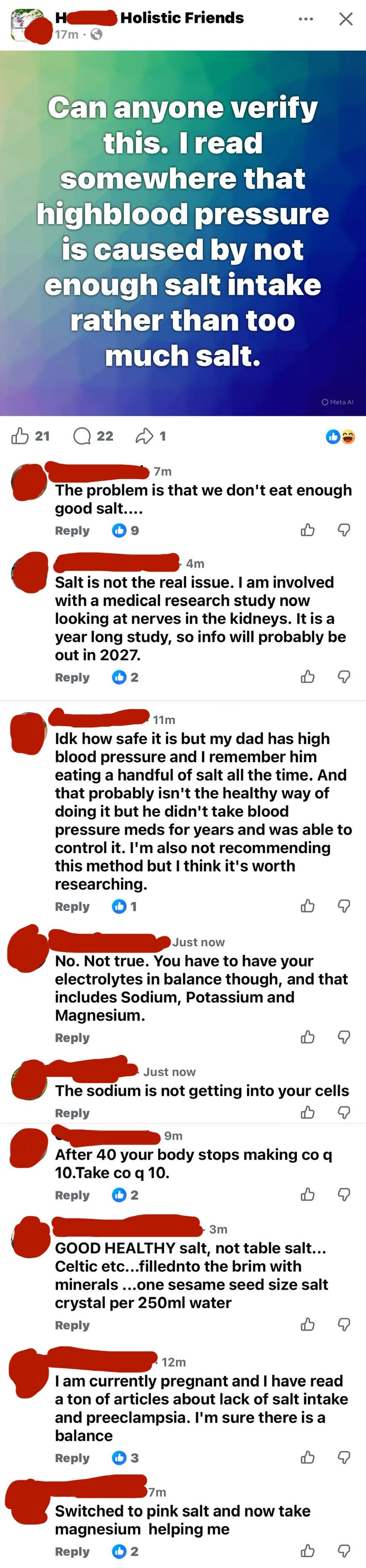
17 minutes worth of randomly offered shitty advice for treating high blood pressure on a Facebook Holistic Health group, ca 1/2026.
The case for antihypertensives
High blood pressure (hypertension), is called the silent killer, because people who have it feel GREAT, and when they take medication for it, they feel less than great. Depending on what they take, they are tired, peeing too much, struggling with erections, or mysteriously coughing for no reason.
Collectively, this makes a lot of people feel like the most prudent choice is to stop taking their drugs, since they feel so much better when they aren’t on them. If I was a pedantic asshole, I could say:
“Hey! You are addicted to high blood pressure! What’s up with that, junkie?”
By the absurd logic of alternative medicine, the argument that you are addicted to your disease rather than the drugs that treat them is still compelling because:
Hypertension feels ideal.
Treated hypertension feels bad.
Cravings for the sensations of untreated hypertension drive harmful behavior to seek the disease state despite significant devastating risks.
Addiction is driven by internal rewards, and if you feel better by either taking heroin or skipping metoprolol… boy do I have some bad news for you about your impending health!
All of the things you hear from pseudoscientists and pseudo-experts like RFK Jr. about diet, lifestyle changes, and detoxes being the cure for every ailment is simply victim-shaming bullshit: i.e., “you are sick because you haven’t worked hard enough to heal yourself.” This can lead to deadly consequences, as is the case for any sort of bad, broadly-stated medical advice.
No diet or regimen of exercise will keep you from getting type I diabetes, sickle cell anemia, multiple sclerosis, or myasthenia gravis. While exercise is usually good for you, exercise can actually hurt or kill you with each of these diseases -particularly if you aren’t treating them.
Detoxing is not a medical thing outside of actual recovery programs for drug addiction. Detoxing from anything else is a pitch employed by influencers to sell supplements and to make diarrhea sound silky smooth and sexy.
All risk factors are not created equally
There are ways to reduce your blood pressure without medications, by working on modifiable risk factors like:
weight
activity level
salt consumption
Tobacco and alcohol abuse
and (my favorite) avoiding stress
These are all levers that you can and should use to control your blood pressure so that you can live long enough to see a Tron movie that doesn’t tank in theaters.
But there are more than just modifiable risk factors. There are these annoying little realities called non-modifiable risk factors for hypertension like:
Age
Biological sex
Family history
Race
If you can change any of these things -especially age, let me know. I have always wanted to try out a time machine.
The sad truth is that sometimes you can lighten your disease burden with hard work and good intentions, and other times you cannot. Such other times demand dutiful medical attention so as to avoid the gruesome details of what untreated hypertension can precipitously lead to.
How detoxing from blood pressure meds led to an aortic time bomb
One fine summer evening in the hospital, the ER called upon me to evaluate a 50 year old man who we will refer to as John. John decided to “detox” from his blood pressure medication earlier in the week. He sought urgent medical attention after he experienced excruciating, tearing pain in his chest and back, with evolving signs of shock.
John had a lifelong history of severe hypertension -by no fault of his; he was actually in excellent physical condition otherwise. His blood pressure had been controlled nicely on two prescription medications. His choice to “get clean” (inspired by the ubiquitous hype of hacks and charlatans) led to progressive superhuman escalation of his blood pressure, as his antihypertensives medications evaporated via the only genuine agents of detoxification: his liver and kidneys.
Now free of restraint, his blood pressure soared to ridiculous heights, putting unthinkable strain upon the integrity of every artery in his body.
The human form is a wonder, but far from flawless. Bones are as strong as wrought iron, but still break. The aorta, largest artery in the body, is mighty but nowhere near as impervious to rupture as the braided steel hose behind your toilet -which also leaks and ruptures once in a while, even though the water pressure it contains is unwavering compared to any human’s wildly fluctuating blood pressure. You think that whooshing noise in your ears after powerlifting or pushing out a rock-hard turd is imaginary? That’s the sound of your acutely elevated blood pressure as it scoots turbulently past your cochlea in times of physiologic stress. Normal to hear once in a while, but it shouldn’t be audible continuously -as it was for John that evening.
Points to chest x-ray: “Hey, does this look swollen?”
Kind of.
John was in the process of suffering an aortic dissection. While this is a catastrophic vascular failure, it isn’t quite as catastrophic as the aorta simply popping open, which occurs with frank rupture. An aortic dissection is more like a dramatic prelude to complete rupture.
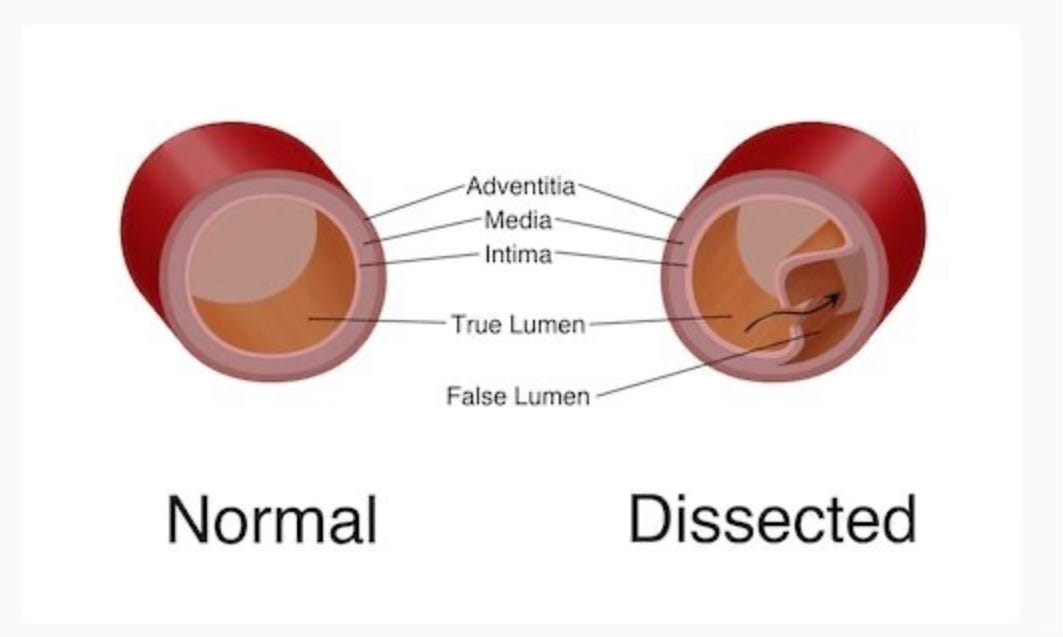
Cross section of a healthy and a dissected aorta. Source: University of Florida Health
Arteries have three layers. The soft inner lining (the intima) tears under stress, and blood is forcibly pumped into the hole created by that tear, but not outside of the external surface (the adventitia) of the aorta itself. The force of the misplaced blood dissects (thus the name of the condition) a new passageway (the false lumen) beneath the intima and within the muscular layer known as the media.
As we say in medicine, this really sucks, because all of that blood stuffed within the walls of the aorta is going nowhere important, like say… your organs. It’s just sitting there not delivering oxygen while fucking up the fortitude of the single most important blood vessel in your body -the one that pumps blood literally everywhere else you need to live (via the true lumen).
Suffice it to say, this was an emergency. Treating John medically with medications carried a mortality of over 70%. Treating him surgically carried a mortality of 5-10% -which still isn’t super reassuring when you’re talking death, but hey… 10 is less than 70.
So we took him to the OR
I gave him drugs to induce anesthesia as gently as possible and prayed they wouldn’t push him over the edge (because they can). They didn’t. It’s better to be lucky than good! It’s also better to be asleep than awake when you are having a breathing tube forced through your mouth and into your windpipe, so things were going well so far!
I placed two massive central lines into his internal jugular vein while my favorite anesthetist placed an arterial line and one more IV in addition to the two John already had, and satisfied that we had enough vascular access to reasonably overcome a bloodbath reminiscent of a Quentin Tarantino film, it was now the heart surgeon’s turn to work his magic -which would predictably require at least a small blood sacrifice.
It was a harrowing, kidney-stone-inducing, 11-hour repair, requiring full cardiopulmonary bypass, deliberate circulatory arrest, almost every vasopressor available to my hospital, and enough transfused blood products to replace every red blood cell, clotting protein, and platelet in his body several times over.
The surgeon yelled at me for not keeping the pressure more stable. I reminded him that no one within a 50 mile radius was trying to die more spectacularly than our shared patient, currently floating in a pool of blood that belonged to him and 20 other donors -so he was lucky to have a blood pressure at all. Surgeons. It was simultaneously a miserable and wonderful night.
John survived. The sun peaked above the horizon through the OR window after a dark and bloody night. Everyone was sore and exhausted from being middle-aged and having to stand in a small area for so long. The dam of John’s dissected aorta had been mended by the surgeon’s expert judgement and skilled hands (despite his crabby disposition).
John’s vital signs were finally stable on a host of drug infusions and the steadfast efforts of a ventilator. We gingerly slid him off of the OR table onto a gurney, transported him to the ICU, delicately lifted him once more to tuck him ever-so-lovingly into his new ICU bed, where he came to rest and promptly went into cardiac arrest via ventricular fibrillation.
So unsatisfying.
CPR on a freshly cut and wired sternum always feels particularly savage -you can feel the bone edges buckling along their manmade joint, just under a stapled skin line that hasn’t had time to even think about healing itself back together yet -and you just can’t help but wonder to yourself:
“is this chest going to bust apart under my hands like that scene from John Carpenter’s The Thing?”
But you gotta do what you gotta do, and obviously this modicum of brutality was absolutely essential for the continuance of John’s life.
With a few rounds of sweat-inducing chest compressions, epinephrine and atropine, the addition of several anti-arrhythmic drugs, and multiple bouts of calling down defibrillating lightning like Thor himself (well… not really, because none of us thought to bring a hammer to this surprise party) -John once again found himself unknowingly but squarely within the realm of the living.
Happy endings aren’t just for massage parlors!
John recovered over the course of a week and left the hospital with a reconstructed aorta, a new aortic valve, a new lease on life, and a newly acquired realization that even though he wasn’t really addicted to blood pressure meds -he really did need those simple, unobtrusive, dirt-cheap pills that literally could have prevented this hair-raising, extremely expensive brush with death.
So if your primary care practitioner tells you to take meds for your high blood pressure, please just do it. You may not feel bad now, but you have no idea how bad you may feel later after wasting time and money on supplements and good vibes.
And if your anesthesiologist cancels your elective meniscectomy because your blood pressure on the day of surgery is 226/119, don’t be mad. We know it’s inconvenient to reschedule, but we just don’t want you to wake up all stroked out, or have to convert from a half-completed knee scope to an aortic arch reconstruction. It’s bad for everyone -you most of all.
ECMO Specialist popping in to say great work doc! I wish folks would just take their losartan and metoprolol. I think on my insurance it’s like $15 for a three month supply of BOTH. Costs so little, does so much.
Our Tron dreams remain eternal. Well done on this. I’m am adequately terrified! Haha! I of course come at this from a policy perspective and consider the regulations around health influencing etc. The caveat emptor perspective of “these statements have not been evaluated by the FDA…” is insufficient. It is impossible for people to be educated on the complexities of every variable of their modern life, particularly medicine. There must be an accountable body that leverages expertise to ensure people have positive health outcomes by delegated authority to regulate industry, with oversight. I imagine a government body that evaluates health claims with rigorous testing and expert review… Wait…does that exist? I must be missing something?